Abbadia Sicille Relais
Trequanda - Località Abbadia Sicille
Book now
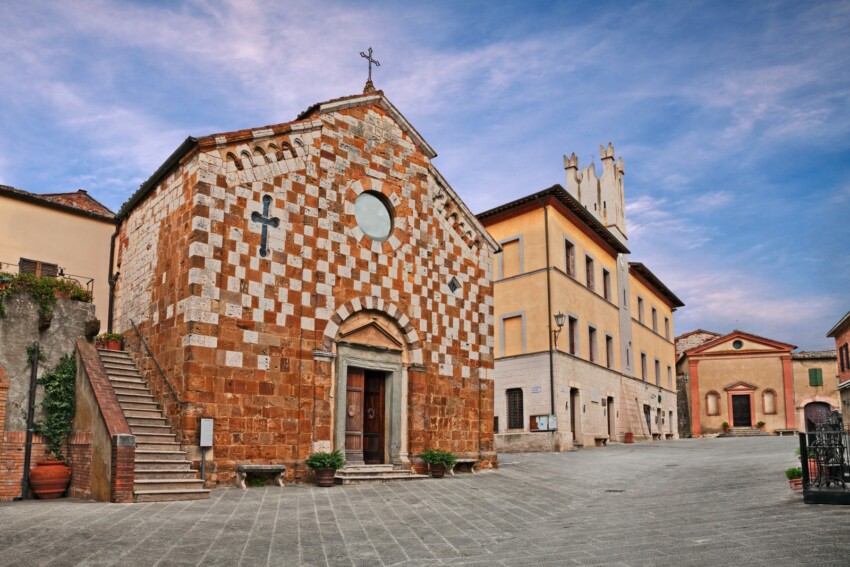
Away from the well-trodden tourist routes, this lesser-known corner of the Sienese countryside in Tuscany boasts artistic, cultural and landscape attractions capable of captivating anyone eager to explore and discover.
The medieval village of Trequanda perches on a hilltop straddling the Val d’Asso to the west and the expansive Val di Chiana to the east, at the centre of which, parallel to the river’s course, the Romans built the Via Cassia after conquering Etruria.
To today’s traveller arriving from the Val di Chiana, the profile of the medieval village of Trequanda will appear much as it did to a medieval knight who, climbing higher, left behind a plain where the Chiana “.. each day losing more momentum, flows sluggishly towards the valley centre and abandons itself to marshy expanses … “
The colour Siena Earth takes its name from the warm ochre tones of the Sienese countryside soil. During the Pliocene period these lands sank until they were invaded by the sea. Later they rose again and the sea retreated, leaving sand and clay that today form the surface layer of the area.
Fossils from the sea still emerge from the furrows traced by ploughs, and the local stone is inlaid with shells of calcified molluscs.
The crete senesi zone, distributed among the municipalities of Trequanda, Asciano, San Giovanni d’Asso and Buonconvento, is a unique and fascinating landscape of bare, undulating clay hills stretching to the horizon, with the occasional oak tree or solitary cypress, isolated farmhouses scattered on hillsides and ridges, patches of woodland in the valleys, and here and there the “fontoni” that collect rainwater.
The always evocative panorama changes with the turning of the seasons. In autumn the bare ploughed earth displays a wide spectrum of shades from icy white to deep brown. In winter the soil greenens with freshly sprouted wheat seedlings which in spring drapes the hills in brilliant green and in summer turns them golden with ripening grain.
On the crete, the pasture lands grazed by flocks turn blood-red with sulla flowers in May and pink with birdsfoot trefoil.
Distinctive land formations include the calanchi, balze and biancane.
The Trequanda territory is rich in lush woodlands whose trees and shrubs are those typical of Mediterranean flora and the mid-mountain Apennine region. In certain areas where the soil is sandy, the vegetation closely resembles that of coastal zones.
Cypress trees are the tree species that most strikes the landscape. Found within woodlands or standing alone to mark a boundary, or aligned in double rows along country lanes, or grouped on hilltops.
The summit of Monte di Piazza di Siena rises to the left of Trequanda and is covered in carpinus woodlands. The Lecceto woodland that overlooks Castelmuzio is composed mainly of holm oaks.
Vines and olives are cultivated on the hills, whilst irrigated valley bottoms yield maize, sunflowers and occasionally tobacco.
Powerful, stately animals with pristine white coats and short horns, Chiana cattle graze freely in the meadows. They have always dominated the Tuscan agricultural landscape and once, before modern farm machinery, these specimens were used to work the fields.
The Sienese lands are home to mystics, saints and preachers, but also merchants, travellers, mercenary soldiers and brigands.
These ancient roads were medieval crossroads for peoples, armies and intense trade routes from every part of Europe.
Built on an Etruscan-Roman site, Petroio was constructed almost entirely in sandstone.
The origin of the name may be found in Pretorio (from the Latin Praetorium), as it is first mentioned in a consistorial bull from the Camaldolese annals of 1180. However, there is another likely theory that traces the name back to the Etruscan Petruni.
It was a fief of the Cacciaconti della Scialenga, subject, like Trequanda, to the authority of the Republic of Siena. Towards the end of the fourteenth century the Castle became a domain of the Salimbeni and later the Piccolomini Bandini before returning under the jurisdiction of the Sienese Republic, remaining there until 1552, when it passed to the Grand Duchy of Tuscany.
The attentive visitor cannot help but immerse themselves in the serene beauty of the ancient village, cloaked in woodlands and enriched with buildings of considerable historical and artistic merit.
The name Brandano is linked to Petroio, born Bartolomeo Carosi. A singular ascetic, preacher and prophet of the fifteenth century, he travelled through his land carrying a skull, a crucifix and a sack, repeating mottos and prophecies still cited by our people.
Casale Mustia in the ninth century stood around the ancient parish church of S. Stefano a Cennano, a splendid early Christian Church from the seventh century, whose current structure dates from 1285.
Castelmuzio presents the typical structure of a fortified castle; gently nestled on a tufa hill, it has a circular plan and is surrounded by walls and bastions.
In the records of the Siena State Archive, in the year 1213, the village appears under the name of Castel Mozzo, perhaps derived from the appearance of the watchtower of Palazzo Fratini, which when viewed from a distance appeared, indeed, “truncated”.
It belonged to the Cacciaconti, then from 1270 to the Republic of Siena and in 1354 to the Hospital of Santa Maria della Scala in Siena. Later dominated by Cocco Salimbeni Lord of Tentennano and by the Piccolomini, in 1552 it returned under Siena following the conquest by the imperial troops of Ascanio della Cornia, and a few years later was annexed to the Grand Duchy of Tuscany
Just before the entrance gate, still fitted with hinges and murder holes, you can see, set into the wall, the stone upon which Saint Bernardino of Siena rested and ate during his visits to the community. The community’s memories are deeply tied to the friendship of the great and holy Sienese figure, a scourge of vice and an exceptional preacher.
Castelmuzio is dominated by Monte Lecceto and overlooks the valley of the Trove stream, which offers visitors evocative panoramas with countless chromatic effects created by the changing hours and seasons that succeed one another over woodlands, fallow fields and olive groves, fading towards the horizon.
What's the weather at Trequanda? Below are the temperatures and the weather forecast at Trequanda for the next few days.
To see all the facilities and book accommodation in Trequanda use the form below, entering the dates of your stay.
 Hotel
Hotel 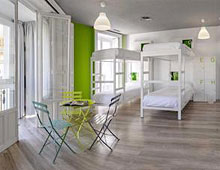 Budget accommodations
  Apartments
  Family Hotel
 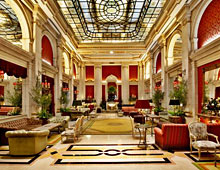 Luxury Hotel
 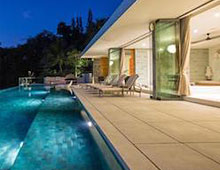 Resorts