Florence: Uffizi Timed Ticket & Masterpieces Audio App
7.148 reviews
Buy now
From 27,20€ per person
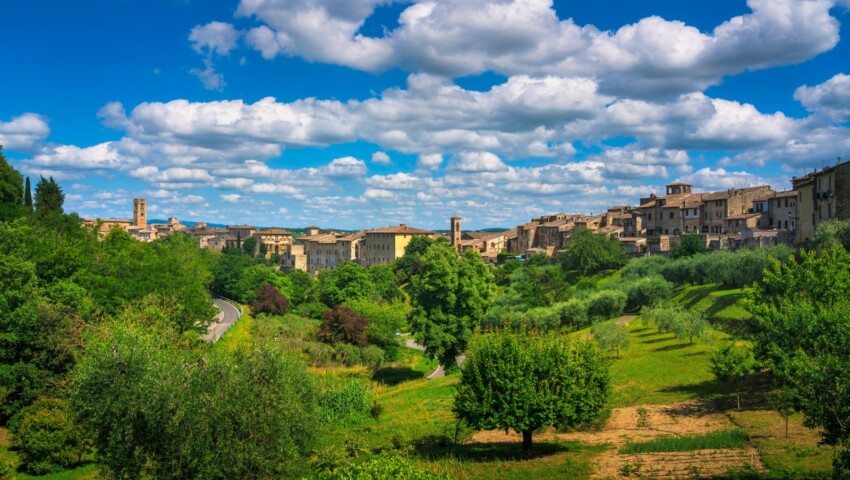
Located in the heart of Tuscany, the Valdelsa region represents not only the ideal destination for those wishing to spend a holiday in Tuscany to visit world-renowned cities of art such as Florence, Siena, Pisa, Lucca, San Gimignano and Volterra, but also a place to rediscover natural, landscape and gastronomic riches of undisputed value.
The strategic importance of the Elsa Valley lies entirely in its routes. It is simultaneously the gateway to the sea, the path of the sacred, the artery that carries Tuscan character from Florence to Siena.
It owes its development to the Francigena pilgrimage route and its inclination towards sustainable economy, which is a continuous and harmonious production (wine, oil, but also crystal and mechanical goods, paper and electronics, ceramics and furniture) precisely because of the encounters that occur along these itineraries. Like the river, the capricious Elsa, which has shaped the landscape’s topography, so too the river of people walking through the millennia has moulded the landscape, the villages and character.
History often delights in playing with apparent contradictions: so whilst the Elsa Valley was first and foremost a passage route, in the last hundred years it has lived apart because penetrating it means deviating from the more customary Tuscan itineraries. This privacy has preserved it and further refined it through a commitment to welcoming visitors that is not tourist commercialism, but genuine hospitality.
It concentrates within itself all the distinctive characteristics of Tuscan identity – art, good food and fine wine, landscape, rural dwellings – and clearly defines its own particular identity, to quote Machiavelli who lived not far from here.
Rarely anywhere else in Italy is history so relevant as in the Elsa Valley. And not only because of the architecture preserved intact in at least three significant locations: San Gimignano, Monteriggioni and Colle in Val d’Elsa – here history is a living book, to leaf through its pages is to converse with the people, to be intoxicated by the aromas, to be satisfied by the flavours, to be enchanted by the landscapes. There are two places where this backwards space-time connection is most palpable, perhaps because the architecture is less striking: Casole and Radicondoli still breathe the natural rhythms of the countryside. They have walls and narrow lanes, Roman villas and rural dwellings, above all they possess an inner metronome that is the rhythm of tradition.
Then there is Poggibonsi. There history plays hide-and-seek because this is among the valley’s towns the one that probably has the oldest and most complex story and yet you must search for it. But contrasting with Poggibonsi, the recent history of this territory resides here and is highly visible. This is where “progress” takes root in the established development of the Elsa Valley.
One would need the spade of an archaeologist, the lens of an anthropologist, the notebook of a historian, the camera of an art historian, and then the palate of a gastronome, the statistics of a sociologist, the introspections of a psychologist and the tables of an economist to understand with scholarly rigour its multiple identities. Yet to us it seems that one instrument serves above all: human openness to let oneself be permeated.
Skilfully shaped by human hands, the rolling landscape is characterised by extensive woodland areas alternating with arable land or areas cultivated with vineyards and olive groves.
Man has been able to reshape the territory whilst keeping intact an environment enhanced by ancient villages and rich in prehistoric, medieval and Renaissance heritage that can still be admired today.
The Valdelsa territory represents an important crossroads for communications in the area around Florence, and is the ideal place for those who, even if drawn by the universally known names of historical figures from the Elsa Valley such as Leonardo da Vinci, Boccaccio and Pontormo, wish to spend their holidays in welcoming and peaceful farmhouses, holiday apartments or hotels with the backdrop of a well-preserved landscape, amongst history, art, nature and tradition that here means above all the production of Chianti wine, olive oil and craftsmanship in ceramics and glass.
Within the town of Colle Val d’Elsa lies a historic and natural landscape of immense value created by the flow of the River Elsa, which crosses the Elsa Valley creating unique and characteristic scenarios found nowhere else. The river forms enchanting corners and creates interesting hiking trails to observe: the engineering works for water collection, the water channels, artificial canalisation systems to bring water into the town, and the caves. A particularly striking spot is the Diborrato waterfall, a 15-metre drop plunging more than 10 metres deep, a sort of small lake where townspeople once went to cool off. Other places absolutely not to be missed are the Bear Cave, the Conchina, the White Rock, the Niche and the Falcons’ Plain, all points with particular landscape characteristics.
Due to this natural wealth, a locally protected area has been established: the Upper Elsa Valley River Park, which encompasses the river’s course through the town of Colle Val d’Elsa, running from Ponte Santa Giulia to Ponte di Spugna, and also including Le Caldane, a thermal spring already known to the Etruscans and Romans.
The construction represented the central role played by Colle Val d’Elsa in the war between Florence and its territories against the city of Siena. Passing through the gate, you enter Via Gracco del Secco, the street that crosses the ancient village, lined with grand residential palaces and hospitality facilities.
Beneath the yellow plastered façade, in the late eighteenth-century style ordered by Pietro Leopoldo of Tuscany, stand the structures of the former San Lorenzo hospital and the former San Pietro conservatory, with its attached church. Both buildings were commissioned by the powerful Usimbardi family, to which belonged the first bishop of Colle Val d’Elsa.
The former San Lorenzo hospital, built in 1635, clearly shows signs of the Leopoldine enlargement carried out by engineer Bernardino Fantastici; whilst the former San Pietro conservatory, completed in 1606 to a design by Giorgio Vasari the Younger, today houses a museum. In the exhibition complex which currently has ample spaces for temporary exhibitions, the city’s collection from the Civic and Diocesan Museum of Sacred Art is displayed, featuring a substantial group of artworks ranging from the medieval period to the twentieth century.
Crossing the Santa Caterina district, you notice the remains of numerous commercial dwellings dating from the thirteenth to sixteenth centuries, in which the original tower-house morphology is still legible, and from Piazza Baios you can admire the turreted structures of medieval buildings in Via dell’Amore and Via del Refe Nero. Of the ancient Porta Vecchia, today only the massive Renaissance tower remains, which functions as a water cistern, from which the hydraulic network of Colle Val d’Elsa’s underground channels departed.
Continuing along the street, you reach the Church of Santa Caterina d’Alessandria from the 1400s, flanked by the Oratory of the Filippini and that of the Company of the Cross. In the square in front of the house identified as the residence of the humanist and Lutheran theologian Aonio Paleario – burnt at the stake in 1570 in Rome – you can pleasantly rest in the shade of the trees to admire the evocative views of the Tuscan hills and the beautiful panoramic vista of the San Francesco church.
The Church of San Francesco, which stands alone on the hill facing the Castle, is reached via a fourteenth-century arched bridge, built to connect the monastery to the Santa Caterina district. From Piazza Santa Caterina, continuing along the main street, you reach Palazzo Renieri-Portigiani, now the Town Hall. The construction of the palace was commissioned by Bernardino Renieri, who held the position of engineer at the French court of Charles IX and was appointed “architect of the Guelph faction” in the service of Francesco I de’ Medici.
 Hotel
Hotel  Budget accommodations
  Apartments
  Family Hotel
  Luxury Hotel
  Resorts