Florence: Uffizi Timed Ticket & Masterpieces Audio App
7.148 reviews
Buy now
From 27,20€ per person
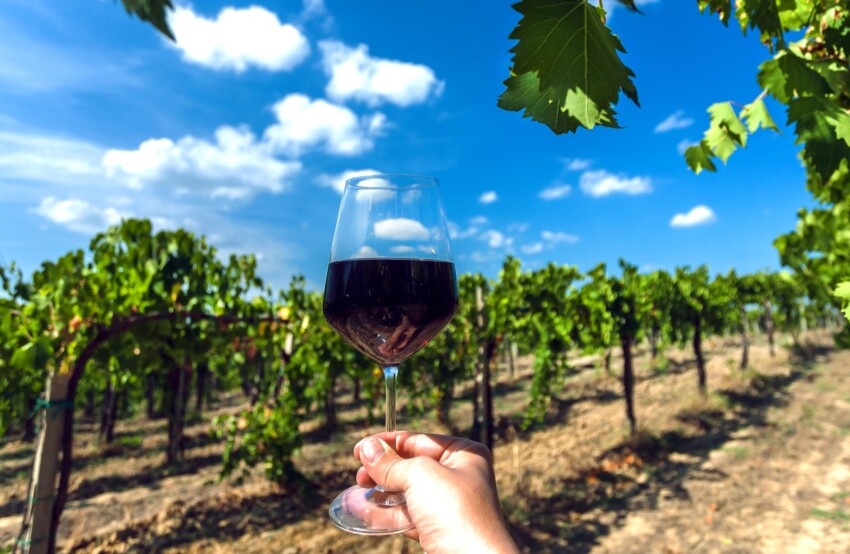
Not all wine produced in Chianti is Chianti Classico. To be entitled to a designation, it is not enough simply to come from a specific territory – all the rules laid down in the production regulations must be adhered to.
The first version of the production regulations for the DOCG Chianti and Chianti Classico dates back to 1984, when Chianti Classico was still considered a sub-denomination of the all-encompassing DOCG Chianti, albeit with separate regulations that imposed stricter production rules than those applied to other Chianti wines.
It was not until 1996 that Chianti Classico achieved its definitive recognition of importance and primacy: with the Ministerial Decree of 5 August, the DOCG Chianti Classico was recognised as an autonomous denomination, establishing once and for all its distinction and independence from other Chianti wines. Subsequently, with the latest amendments to the regulations in 2002, new qualifying rules were introduced for both the product and the denomination.
A significant innovation concerns the ampelographic basis (that is, the types of grape that can be used in the production of a wine).
Under the new regulations, the minimum percentage of Sangiovese (a red grape variety typical of the area) has been raised from 75 to 80%, and it can of course be used in its pure form (up to 100%). Alongside Sangiovese, other red grape varieties may be present – indigenous ones such as Canaiolo and Colorino, and other “international” varieties such as Cabernet Sauvignon and Merlot – up to a maximum of 20%, whereas white grapes, Trebbiano and Malvasia, can no longer be used from the 2006 vintage onwards.
The minimum alcohol content is 12° for standard wine and 12.5° for Riserva. However, other very important production factors are required for a wine to be called Chianti Classico: a new vineyard enters production four years after planting, the yield per hectare cannot exceed 75 quintals (equivalent to 52.5 hectolitres of wine), and each plant must produce a maximum of three kilograms of grapes.
To ensure harmonious balance between all the various components of Chianti Classico wine, release for consumption is permitted from 1 October following the harvest. For Riserva wines, a minimum mandatory ageing period of twenty-four months is required, with at least three months of bottle maturation.
In addition to the alcohol content mentioned above, Chianti Classico wine must by law have specific characteristics, which are:
Finally, and a matter of fundamental importance, the regulations require that, in addition to vinification, the operations of storage, bottling and bottle maturation must also take place within the production area.
The most important grape that contributes to creating Chianti Classico wine, accounting for between 80 and 100%, is Sangiovese. This is the grape variety that today distinguishes all the most important red DOC and DOCG wines of central Italy. It is a variety very sensitive to external factors, whether soil or climate, and its ripening is certainly not early and is sometimes irregular.
However, it is difficult to find another grape variety that can interpret the characteristics of a soil so well and modify its aromas according to the terrain on which it grows: thus a floral bouquet suggests sandy soils, red berries suggest limestone, fresh tobacco suggests tuff. Yet in all cases, that distinctive note of violet should always be found – the very element that the production regulations identify as the characteristic and specific hallmark of Chianti Classico.
Other red grape varieties, typical of the region or international, may accompany Sangiovese, but Sangiovese is the soul of Chianti Classico, so much so that the 1996 production regulations already allowed for the possibility of using it in its pure form.
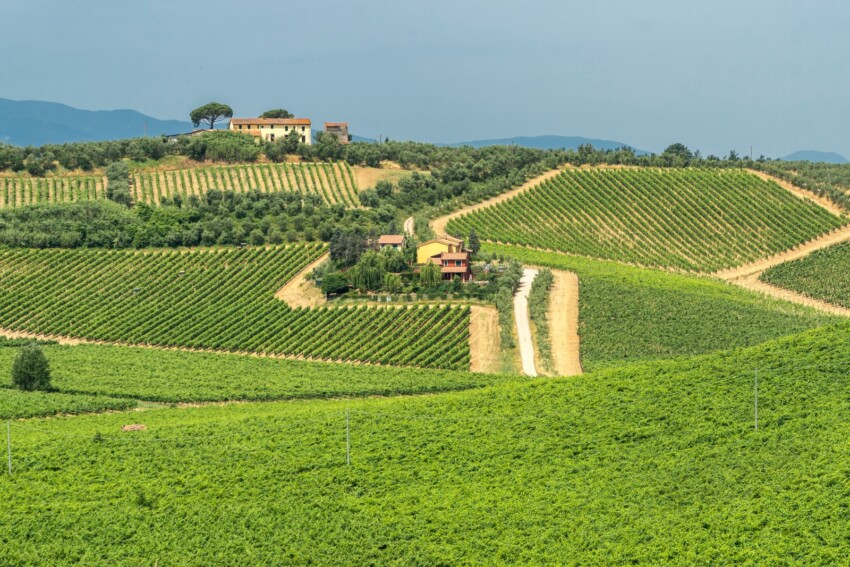
Traditional training methods are represented by the Guyot system and a variant of it known as the Tuscan arch. However, the cordon training system is now very widespread in Chianti, particularly in new vineyards, as it offers considerable potential for mechanisation and can produce quality fruit. The soil is worked several times each year if the traditional cultivation method is chosen; increasingly, however, the practice of inter-row vegetation is taking hold, particularly in steep vineyards, to allow better water management and thus limit erosion.
Around mid-April, the vines awaken vegetatively, with buds opening to produce new shoots. Flowering occurs in the first week of June – the vine’s tiny white flowers are extremely fragrant and resemble snowflakes under a microscope – with fruit set following at the end of the month, when the flower transforms into fruit.
The small Sangiovese grape is initially green in colour; the heat of July and the first days of August will cause it to progressively darken (véraison); from this moment begins the ripening phase, which will enrich the berries with all those substances necessary for producing a great wine (sugars, polyphenols and aromas) and reduce acidity levels to optimal levels. September is perhaps the most important and most delicate month for ripening: the temperature fluctuations between sunny days and cool nights allow for the completion of a long process. Finally, October is the month of harvest, which takes place at different times depending on the grape variety and its level of ripeness.
In the lower areas – San Casciano, the low-lying hills of Greve and Castellina, Castelnuovo Berardenga – harvesting may begin as early as late September; the ripening of grapes is slower in Radda, Gaiole, Panzano and the higher reaches of Castellina.
Once in the cellar, the grapes undergo crushing and destemming, which removes the stems and produces the must. This is then transferred to various types of fermentation vessels where alcoholic fermentation begins, characterised by an initial tumultuous phase with the development of temperatures, generally below 30°. Depending on the vintage and therefore the characteristics of the grapes, the duration of skin maceration varies, but generally lasts around two weeks.
During this period, the grape skins, pushed upwards by the gases produced as the yeasts convert the must’s sugars into alcohol, form a compact mass called the cap. To extract the maximum from the raw material, pumping over and punching down operations are performed (breaking up the cap) to extract from the skins the polyphenols, which give colour and provide longevity to the wine, as well as the aromatic compounds on which the complexity of the bouquet depends. This is followed by pressing, or the separation of the pomace from the free-run wine, on which the second fermentation occurs – the malolactic fermentation, in which the action of lactic acid bacteria transforms the aggressive malic acid into the softer lactic acid.
To gradually achieve clarity in the product, March and April are the months designated for racking, the final racking traditionally being carried out at the moment of vine flowering, which signals the arrival of summer warmth. Wine destined for early release remains in tanks or rests in wooden casks for a time longer, whilst Chianti Classico destined to become Riserva begins its long period of wood ageing.
Many roads cross the Colli Fiorentini and the territories of the municipalities that fall within it: Bagno a Ripoli, Barberino V.E., Certaldo, Fiesole, Figline V.no, Firenze, Impruneta, Incisa V.no, Lastra a Signa, Montelupo F.no, Montespertoli, Pelago, Pontassieve, Reggello, Rignano S.A., San Casciano V.P., Scandicci, Tavarnelle V.P.
From four main routes branch off many minor itineraries where you will often discover the most precious and authentic aspects of the Florentine hills.
 Hotel
Hotel  Budget accommodations
  Apartments
  Family Hotel
  Luxury Hotel
  Resorts