Bestseller
Florence: Chianti Wineries Tour with Wine Tasting
From 49,50 €
Buy the ticket
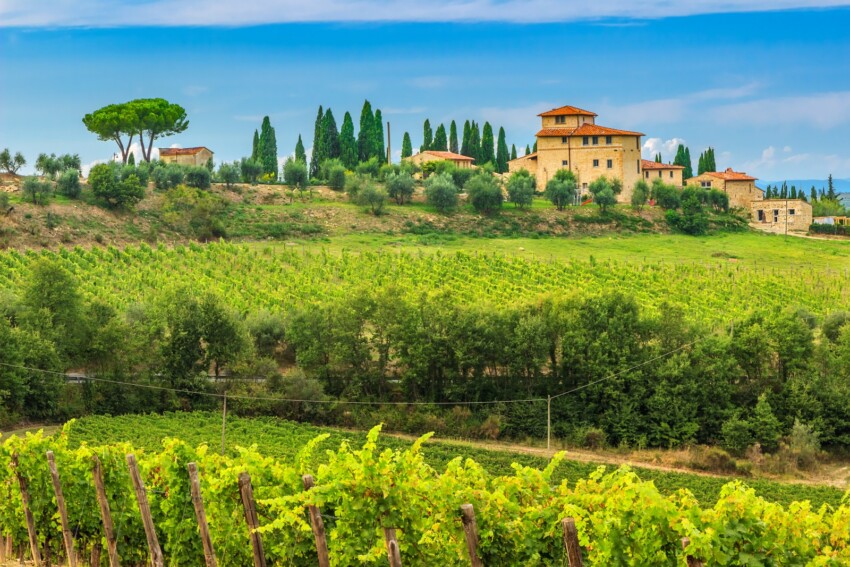
The Chianti region, with its succession of incomparably beautiful rolling hills, lies at the heart of Tuscany. Split administratively between the provinces of Florence, Arezzo and Siena, during the Middle Ages it was bitterly contested between the two rival cities until 1555, when the Medici imposed their dominance over all of Tuscany.
Its boundaries are difficult to define precisely, since only the Chianti Mountains to the east separate it clearly and naturally from the Upper Arno Valley; the rest of the territory blends into the hills of the Arbia, Elsa, Greve and Pesa valleys.
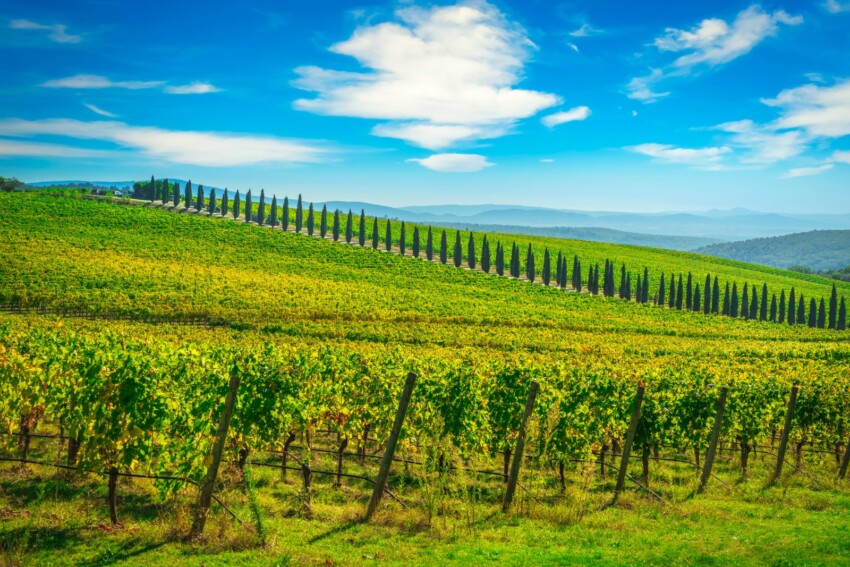
Medieval villages, castles, churches, abbeys, monasteries, farmhouses and villas follow one another along a remarkable route that showcases human industry and ingenuity; centuries of work have shaped the hills of this region, and the interplay of vineyards, olive groves and woodlands creates a harmony found nowhere else in the world.
You can explore Chianti with complete freedom, moving from one village to another, or follow two itineraries along the main routes that cross the region:
In any case, what awaits the visitor is an unforgettable landscape, always varied and harmonious, so different in colour and atmosphere as the seasons change. There are numerous detours you can make to reach a parish church, a castle or an isolated village, silent witnesses to the historical and artistic wealth of Chianti.
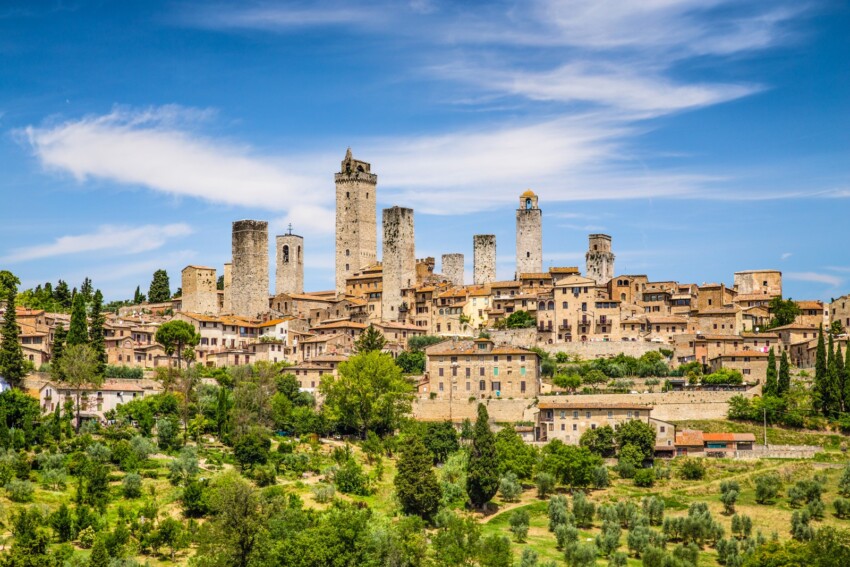
In central Tuscany, at the edge of the eastern part of Chianti, lies the Val d’Elsa, another area recommended for those who love the soft Tuscan landscape and medieval atmospheres: here you’ll find some of Tuscany’s most beautiful villages.
One of these is San Gimignano: if you have time to visit just one village, head straight for this delightful hilltop town with its distinctive medieval silhouette.
More than 10 towers rise from the centre of San Gimignano towards the sky, like powerful stone fingers reaching out to touch the blue. An emotional sight for those arriving, and it’s merely a prelude to the other-worldly atmospheres that await you as you wander through the town centre.
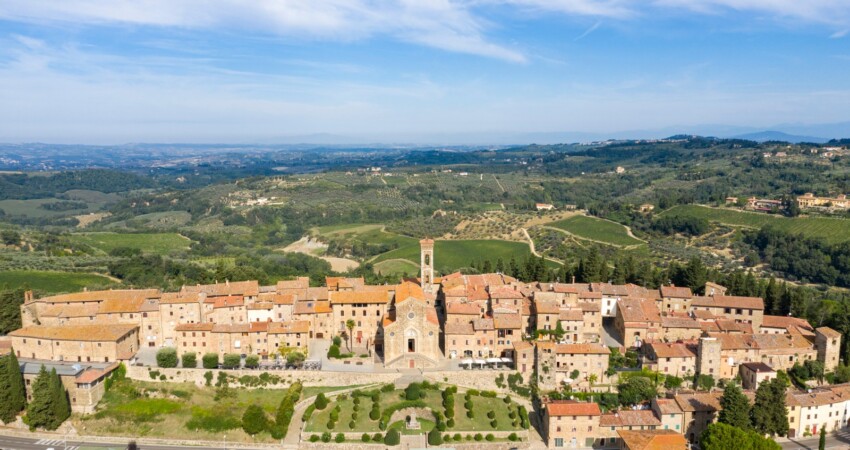
Founded by the Florentines in a strategic position to counter the expansion of the Semifonte castle, Barberino Val d’Elsa still retains a medieval character with fortified walls, tower houses and some interesting buildings including the Palazzo Pretorio (14th century), the Spedale dei Pellegrini (14th century) and the church of San Bartolomeo.
From Barberino, following the road to Certaldo, you can reach the remains of the Semifonte castle destroyed by the Florentines in 1202 after a long siege. Not far away, at the end of the 16th century, the chapel of San Michele Arcangelo was built to a design by Santi di Tito in memory of Semifonte. Also in the direction of Certaldo stands the Romanesque church of San Appiano, one of the oldest in the Florentine countryside, dating from around the 11th century. The cruciform pillars in front of the church are noteworthy, bearing witness to the existence of an ancient baptistry.
After Barberino Val d’Elsa the Via Cassia continues but leaves Chianti. Those wishing to follow it can visit Poggibonsi, Colle Val d’Elsa and Monteriggioni and then reach Siena. A detour from Poggibonsi to San Gimignano is recommended.
A “border” locality in Chianti, situated in the south of the region, Castelnuovo Berardenga is an interesting destination to visit, whose original core dates back to the 9th century when it was a feudal complex called “terra berardinga”, though only a 14th-century tower and a stretch of walls remain from its ancient layout. Of considerable architectural significance, however, is the Villa Chigi Saracini, with its large park, which overlooks the town.
Also noteworthy is the church of Saints Guido and Clement (1843-1846), designed by Agostino Fantastici on commission from Count Agostino Saracini, and the oratory of the Company of Santa Maria del Patrocinio (1851-1860), a work by Andrea Chiusarelli, with its pitched façade of travertine and plaster, built to honour a 14th-century polychrome terracotta depicting the Virgin Mary, which the inhabitants of Castelnuovo Berardenga believed was their community’s protector, crediting the Madonna – called for this reason ‘del Patrocinio’ – with having saved their land from invasions and wars on numerous occasions.
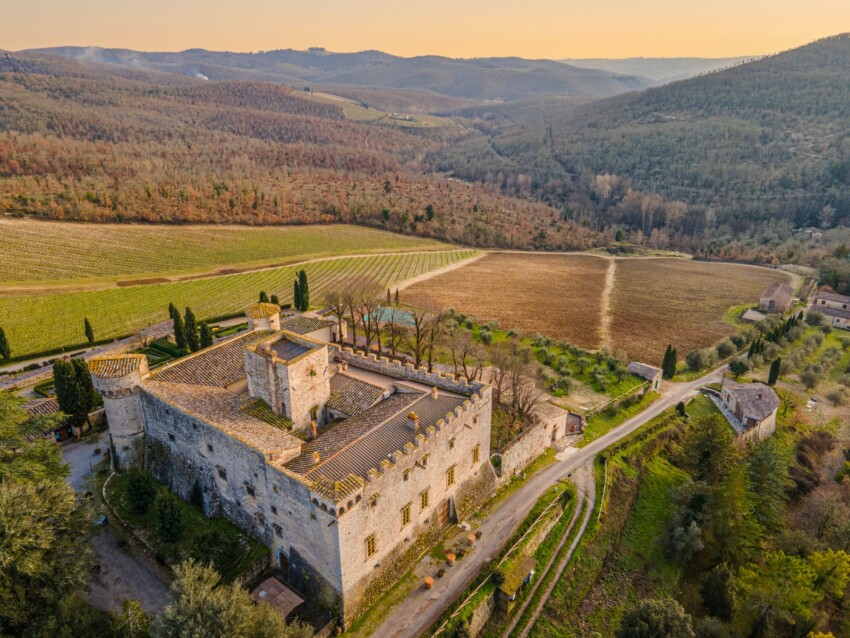
Gaiole in Chianti was an important medieval settlement that developed along the road to the Valdarno. The numerous castles and parish churches in the area bear witness to intensive and prosperous agricultural and commercial activity. Among the castles, those of Vertine, Meleto with its two impressive round corner towers, Barbischio and above all Brolio castle are particularly interesting. The castle’s walls and bastions are encircled by a sentry walk from which you can enjoy a magnificent view of Chianti and the Siena countryside. Completely destroyed in 1478, the castle was rebuilt in the last century at the behest of Bettino Ricasoli.
Less than 1 km from Gaiole, visit the beautiful Romanesque church of Spaltenna, whilst on the road to the Valdarno, set among the greenery of age-old firs, the Badia a Coltibuono is worth a stop. Much of the imposing abbey complex built by Vallombrosan monks in the 11th century is today privately owned; the Romanesque church remains, with a massive crenellated bell tower.
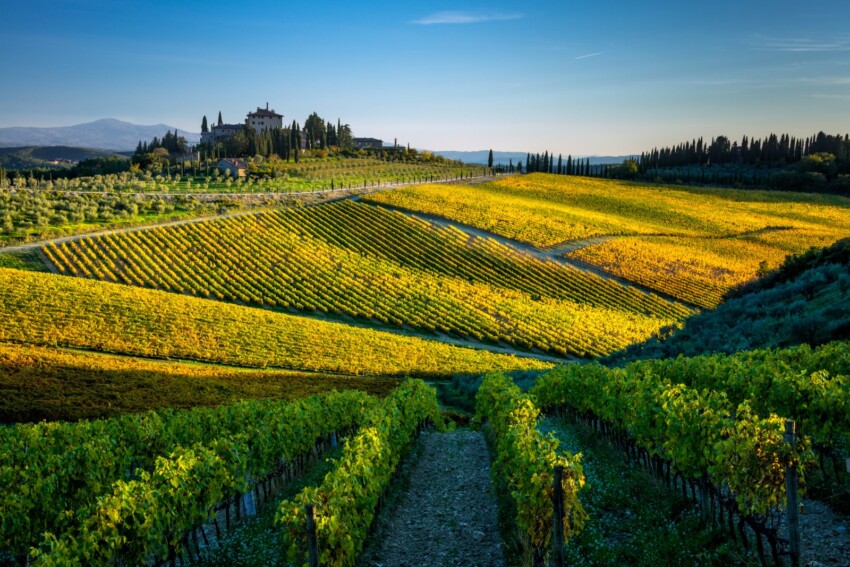
On the border between the provinces of Florence and Siena, Radda in Chianti is an ancient village of medieval origin, of which only a few stretches of walls and some towers remain. The 15th-century Palazzo Pretorio, adorned with civic emblems, is noteworthy. Not far from Radda, in the direction of Lucarelli and Panzano, you’ll find the entrance to the Romanesque church of Santa Maria Novella, unique in the Chianti territory for its capitals decorated with zoomorphic symbols, monstrous figures and floral designs reminiscent of Romanesque churches in the Valdarno and Casentino.
Also visit the castle of Volpaia, a small medieval settlement where, within the walls, you’ll find a maze of well-paved and well-preserved alleyways among arches, palaces and the small Renaissance church of San Eufrosino (15th century).
A hamlet of Greve in Chianti, Panzano is also a destination not to be missed during any self-respecting Chianti tour. The historic village sits atop a hilltop, dominated by the castle, which forms its original nucleus. It’s still possible today to observe the ancient surrounding walls, though they have been modified over the centuries.
Today the historic village, the so-called Panzano Alto, can be visited comfortably by walking two roads that, starting from the small piazza, run parallel to the castle. Along both roads, of course, you won’t lack shops where you can taste the excellent wine produced in these parts. The buildings overlooking them are also very beautiful, late medieval and Renaissance structures.
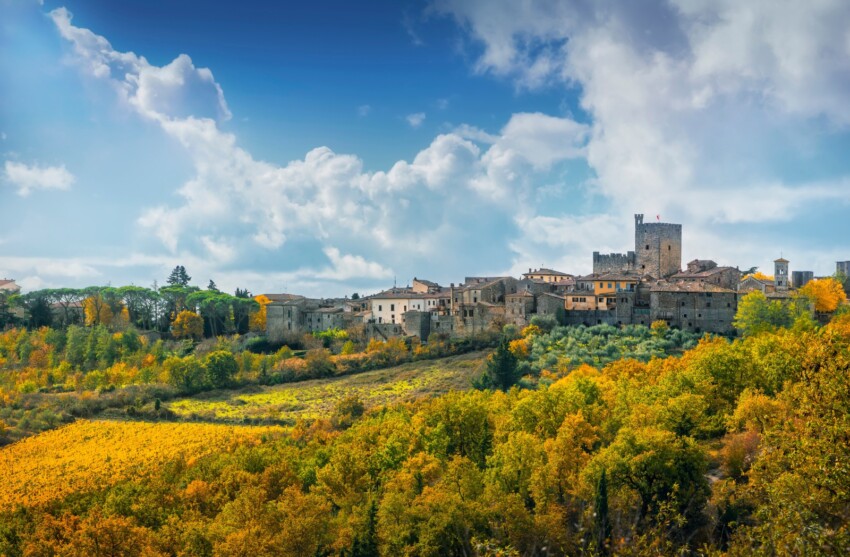
An ancient fief of the Trebbio family, Castellina in Chianti became a Florentine possession in the 15th century. The surrounding walls and fortress dominating the town date from this period; but what more than anything bears witness to Castellina’s medieval past is undoubtedly Via delle Volte, a semi-underground passage through the walls whose loopholes offer exceptional panoramic views.
Just outside the town centre is the Etruscan hypogeum of Montecalvario, a rather imposing tumulus dating from the 7th-6th century BC which, together with other tombs found in various locations, testifies to the Etruscan presence in Chianti. Further away, but still noteworthy, is the old castle of Monternano, whose ruins can be visited.
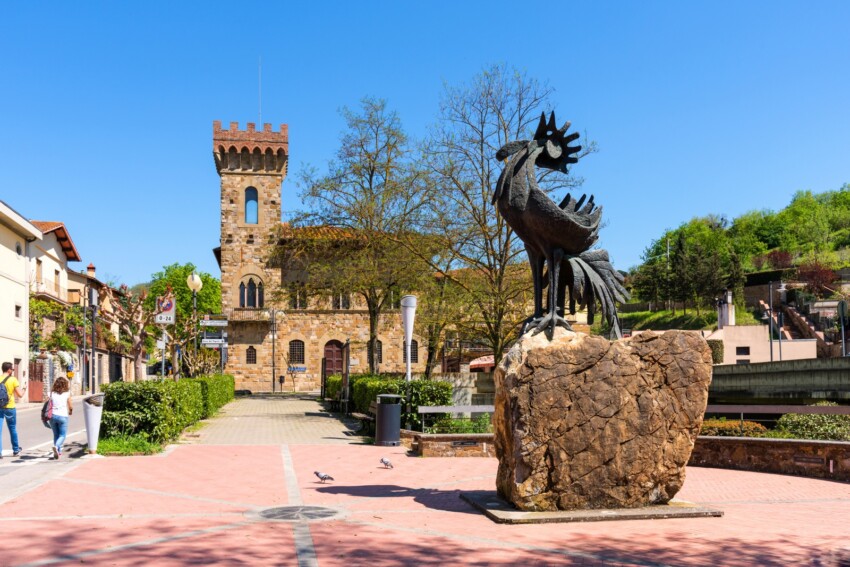
Situated at the crossroads of roads connecting Florence to Siena and the Upper Valdarno to the Val d’Elsa, Greve in Chianti is today in the province of Florence and is one of the main tourist destinations in Chianti. Its main square, with its distinctive irregular triangular shape bordered by beautiful arcades, remains an important trading point today, particularly during the Chianti Classico Trade Fair held every September.
Dominating Greve is the castle of Montefioralle, which still maintains the intact original structure of a medieval village with a narrow road winding circularly until it reaches the little church of San Stefano, where an interesting 13th-century Madonna and Child is preserved. The castles of Uzzano, Verrazzano, Vicchiomaggio and Lamole are also notable. Not far from Greve, in the direction of Panzano, stands the Villa di Vignamaggio, where, according to tradition, Monna Lisa, made famous by Leonardo, was born.
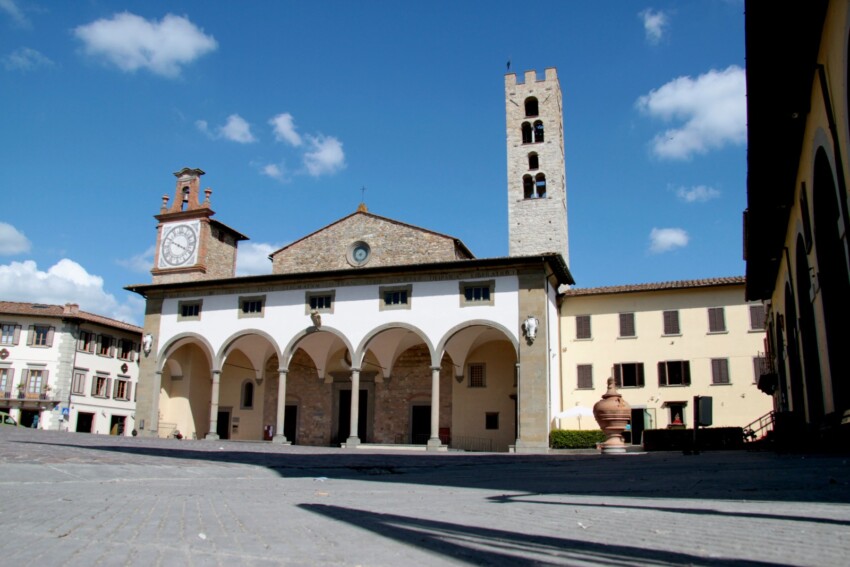
Already inhabited during the Etruscan and Roman periods, Impruneta is a municipality in the province of Florence that’s worth visiting. It’s one of the gateways to Chianti, and once you arrive in the town don’t miss the Church of Santa Maria, founded in 1060 originally in Romanesque style, but which underwent numerous modifications over the centuries so that it now retains only the original crypt, whilst the church presents a sober Renaissance appearance. Inside are works by important artists such as Michelozzo and Luca della Robbia, and a miraculous icon of the Madonna is venerated, which tradition says was painted by the Evangelist Luke.
The cult of the Madonna of Impruneta favoured the accumulation of precious gifts and ex-voto offerings over the centuries, now preserved in the Museum of Sacred Art adjacent to the church, along with illuminated manuscripts, goldwork and silverware. Thanks to the great tradition of terracotta and tile kilns, Impruneta terracotta became a characteristic and distinctive element of Tuscan architecture and landscape, as well as a famous product exported worldwide.
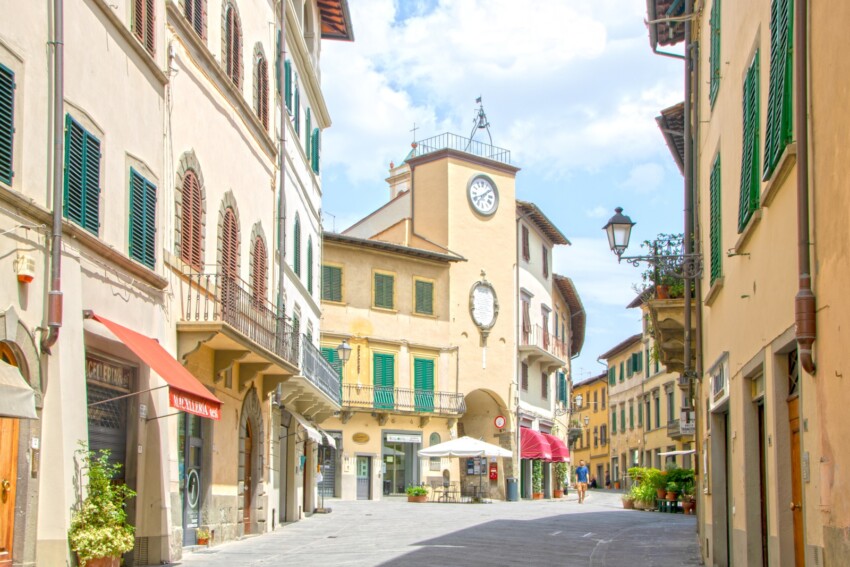
San Casciano Val di Pesa is located in the valley of the Pesa river, which flows through Chianti. It’s a locality on the outskirts of Florence, which is worth visiting to admire the traces of its medieval walls and towers.
The Museum of Sacred Art set up inside the Church of Santa Maria del Gesù houses fine works of art from the area: among the most important works we point out the dossal attributed to Coppo di Marcovaldo depicting Saint Michael the Archangel and scenes from his legend and the Madonna and Child by Lorenzetti. In the town, also visit the main monuments, such as the Collegiate Church and the Church of Mercy (or Santa Maria al Prato) which preserves a rich collection of artworks including a Crucifix by Simone Martini.
Tavarnelle owes its name to the “tabernulae”, resting and refreshment places along the “via regia” that united Florence to Siena and thus to Rome. The area has numerous interesting churches and parish churches, including the Church of Santa Lucia al Borghetto (13th century), a former Franciscan convent in Gothic style which preserves a fine 14th-century school crucifix and an Annunciation by Neri di Bicci.
Just outside Tavarnelle, leaving the Via Cassia, you come to Morrocco where you can visit the Church of Santa Maria del Carmine, built in the 15th century and later extensively modified. Inside are preserved a terracotta glazed Annunciation in the manner of Andrea della Robbia and a series of fragments of 15th-century frescoes. Not far from Morrocco is the ancient Romanesque church of San Pietro in Bossolo, in whose rectory the Museum of Sacred Art has been set up, where works from the churches of abandoned small settlements are preserved: among the most important works we point out a series of panels from 1473 by Neri di Bicci for the Church of Santa Maria al Morrocco and an altarpiece with the Madonna and Child between Saint Martin and Saint Sebastian by the so-called Master of Tavarnelle.
Located in the municipality of Tavarnelle, San Donato in Poggio certainly merits a visit during a Chianti tour. It’s a medieval village that still retains noteworthy remains of its surrounding walls, 13th-14th century buildings, the Renaissance Palazzo Malaspina, the Church of Santa Maria della Neve (15th century) in Gothic style and the Romanesque church of San Donato which preserves a fine glazed terracotta baptismal font by G. della Robbia.
North of San Donato, on the road from Sambuca to Greve, you encounter the imposing Badia a Passignano, founded in 1049 by monks of the Vallombrosan order. Set in the countryside, surrounded by intensive olive cultivation, the abbey strikes one with its fortress-like appearance with crenellated walls and towers. Among the numerous artworks preserved in the abbey, mention should be made of the frescoes by Passignano (1601) in the main chapel of the church and especially the Last Supper frescoed by Domenico and Davide Ghirlandaio (1476-77) in the monastery’s refectory.
In the following map you can see the location of the main places of interest mentioned in this article.
A selection of excellent properties nestled in the Chianti countryside, providing an ideal base for your Tuscan break.
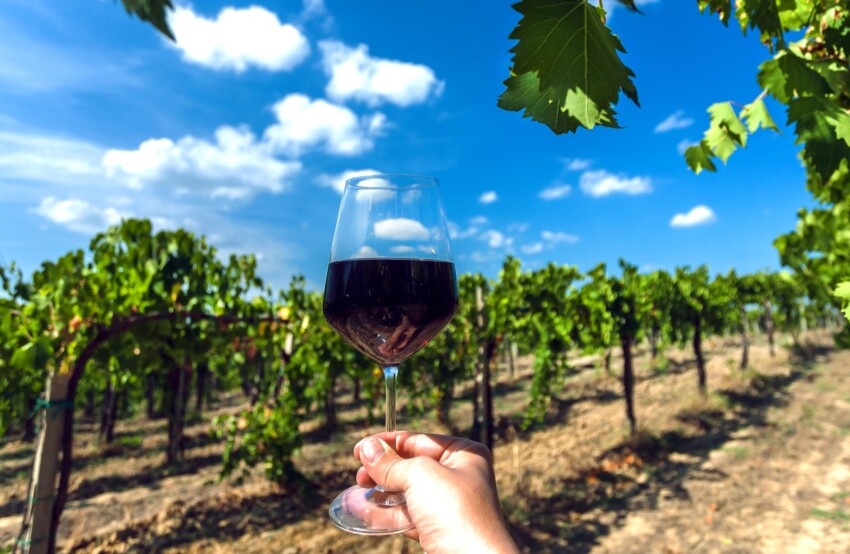
The Chianti wine is a true icon of Tuscany. Produced in the region of the same name, it has held DOCG status since 1984. Its production is subject to strict regulations regarding grape varieties—it must be made from at least 70% Sangiovese grapes, whilst Cabernet Franc and Cabernet Sauvignon cannot exceed 15%.
There are also strict rules governing the production techniques that producers must follow to ensure consistently excellent quality, with a lively ruby-red colour and intense aroma. Chianti wine has a dry, savoury and tannic flavour, and is produced across seven sub-zones: Colli Aretini, Colli Fiorentini, Colli Senesi, Colline Pisane, Montalbano, Montespertoli and Rufina. It comes in two types: riserva and superiore, with the finest expression designated as Chianti Classico.
Chianti wine producers are united within the Chianti Classico Consortium, which has approximately 600 members, and the Gallo Nero Consortium, which promotes and champions these wines. Whilst a 1967 ministerial decree recognised a single controlled designation of origin for Chianti, Chianti Classico is now regulated under even stricter standards.
The reason Chianti wine bears the symbol of a black rooster dates back to an ancient legend: when Florence and Siena were locked in dispute over their borders, the two republics decided to settle the matter with a challenge. At cockcrow, a knight from each city would ride towards the other—Florence towards Siena and vice versa—with their meeting point marking the new boundary. According to legend, the two knights met at the Fonterutoli castle, and the border was subsequently established near Castellina in Chianti.
 Hotel
Hotel  Budget accommodations
  Apartments
  Family Hotel
  Luxury Hotel
  Resorts