Florence: Uffizi Timed Ticket & Masterpieces Audio App
7.148 reviews
Buy now
From 27,20€ per person
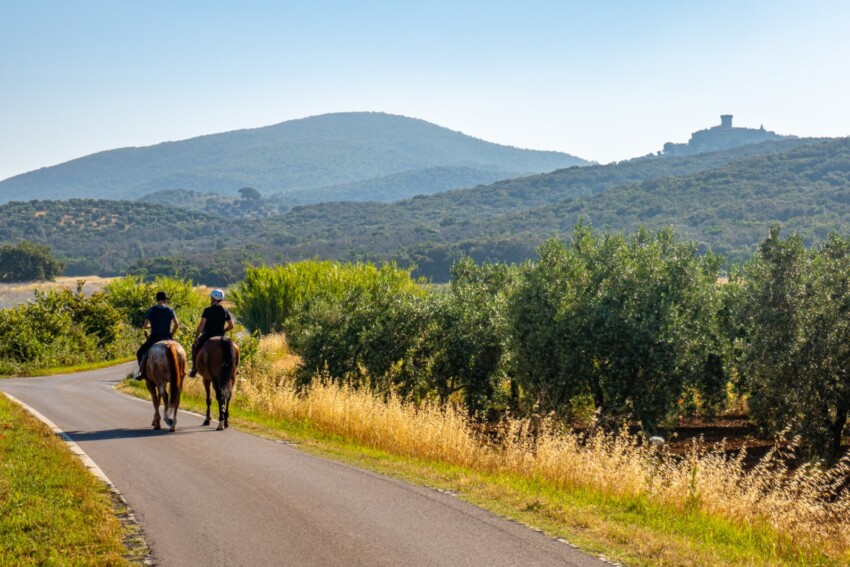
Discovering Tuscany on horseback means living a dream in which your holiday takes on an extraordinary, distinctive and unprecedented quality. It’s about your relationship with nature, far from the noise of engines and close instead to the environment and its surprising characteristics.
Spectacular landscapes await you in some of the region’s most beautiful places, exclusive equestrian tourism itineraries to be explored along the Bridleways of Tuscany, which wind their way along rare and beautiful routes, following the slow rhythm of horse rides on excursions that will touch places of art, the best of Tuscan countryside and mountains.
The itineraries are numerous and will allow you to venture into authentic territories, where you can breathe in the scent of tradition and the seduction of the landscape between villages and castles, forests and white roads. Enchanting itineraries such as the Via dei Cavalleggeri, the bridleway that connects all the coastal watchtowers in the provinces of Pisa, Livorno and Grosseto, and which, starting from the Maremma, crosses the Maremma Regional Parks, San Rossore and the Apuan Alps, rejoining the Via Francigena in Lunigiana.
Roads that sometimes smell of history, at other times of mysticism. Unforgettable atmospheres that you can also experience by crossing the Bridleway of the Sacred Forests, one of the most enchanting places to visit in Casentino. Here you can ride towards castles, abbeys and monasteries. Among these are the Pieve di Romena, the castles of Porciano, Montemignaio and San Niccolò, the Abbey of Vallombrosa and the Hermitage of Camaldoli. Equally fascinating is the Amiata Bridleway, a route through centuries-old chestnut trees and ancient flavours typical of mountain people, amongst travertine boulders, still amongst beeches, softened by coats of moss.
Don’t miss the San Jacopo Bridleway either, which represents an important North–South route linking to the Francigena, covering the territories of the Pistoiese Apennines. The paths of this horse-riding tourist route all develop around the provincial capital on largely unpaved roads and public paths. Stages that allow you to visit historic sites, villages and panoramas.
Among these we mention Vinci, the birthplace of Leonardo’s Genius, Carmignano and its wines, Comeana and the Medici Villa of Artimino. Finally, the dream of an equestrian holiday cannot but also pass through the Bridleway of the Lands of Siena and its landscapes, in a route that offers horses and riders the possibility of staying well away from tourism seen as a consumer good. You move in apparently remote places but Siena and the Piazza del Campo with the Mangia tower are never far away. So all that’s left is to set off: Tuscany on horseback awaits you.
For those who love a holiday filled with medieval atmospheres and contact with nature, we recommend visiting Casentino, in the upper Arno Valley, the land of castles, Romanesque parish churches, Robbian terracottas and places associated with Dante and famous religious sites.
You’ll be able to discover fascinating places, dominated by the striking beauty of lush nature. And you can do so especially on horseback, thanks to the bridleway that connects most of the historic and medieval sites in the Valley and also neighbouring areas such as the Abbey of Vallombrosa. Along the easy routes there are numerous quality accommodation facilities capable of providing adequate assistance to horses and riders, and authorised guides will be able to accompany you in complete safety. You can venture along pathways and get closer to local excellence, renowned throughout Italy and the world: from wood craftsmanship to wrought iron, from stone to “woollen cloth”.
So what are you waiting for? Head to Tuscany and immerse yourself in the magical atmospheres of Casentino and its places, beloved and celebrated by Dante and D’Annunzio, places where famous men of faith founded their spiritual seats such as Saint Francis and Saint Romualdo, respectively at La Verna and Camaldoli. Mysticism and harmony of nature to be enjoyed on slow horse rides, to savour every corner of a territory unique in the world.
Do you dream of riding among the centuries-old chestnut trees and ancient flavours typical of mountain people? Then your dream can become a reality. You can indeed discover one of the absolutely most fascinating areas of Tuscany right on horseback: Amiata. An ancient sleeping volcano that preserves heat and energy. Of its past upheavals, imposing travertine boulders remain, still amongst beeches and chestnuts, softened by coats of moss. It gently stretches out its slopes merging with the wild Maremma to the west and with the rolling lands of Siena to the east.
Itineraries that you can follow thanks to the Amiata Bridleway, which provides two routes. The first, called “A” – High Loop, is a single stage of approximately 30 km and reaches 1,250 metres above sea level. The second route, called “B” – Low Loop, is organised in 4 stages for a total of 80 km and reaches a maximum altitude of 1,230 metres above sea level. Both itineraries allow you to discover the mountain in its most unusual and interesting aspects, for a holiday you’re unlikely to forget.
Amiata indeed preserves ancient wisdom, a deep knowledge with which it has nurtured its large family of simple and strong men and women: woodcutters, charcoal makers and carpenters have always found their source of livelihood in the forest. From chestnut flour, polenta was produced, a fundamental food in local culture that marked the “civilisation of the chestnut” from the 8th century onwards. It is indeed chestnuts that are the greatest and most important product that nature and art provide to the inhabitants of Montamiata.
Tender or ripe, fresh or dried, raw or cooked, ground into flour and then made into Nicci, Castagnacci, Fritters and Polenta. Traditions, culture and landscapes in which you can venture thanks to the roads to be travelled on horseback, for slow tourism that allows you to enjoy the beauties of Amiata, in the right way and at the right pace, in a particular and fascinating atmosphere.
The Via dei Cavalleggeri is a bridleway that connects all the coastal watchtowers of the provinces of Pisa, Livorno and Grosseto and which, starting from the Maremma and crossing the Maremma Regional Parks, San Rossore and the Apuan Alps, rejoins the Via Francigena in Lunigiana. The project retraces the coastal defensive system of the Grand Duchy of Tuscany, which consisted of towers and forts connected to each other and to fortified urban centres along the coast, by way of the via dei cavalleggeri. In fact, from the 17th century onwards, accommodation and shelter positions were added alongside the towers for the “Cavalleggeri Corps” tasked with coastal surveillance.
They constituted a continuous line of 81 fortified locations at an average distance of approximately 3.5 km from each other. This system had expanded after the 16th century, in line with the expansion of the grand-ducal territory, incorporating and strengthening the defensive systems of the Principality of Piombino and the State of the Presidios. The via dei cavalleggeri represents a piece of great history, a road created to protect the territory from dangers coming from the sea: pirates and corsairs, disease and smuggling, which was the coastal defensive system of Tuscany.
The Casentino Bridleway route winds along 210 km divided into six stages and touches some of the most evocative places in the area such as the villages of Bolgheri, Montescudaio, Castelnuovo Misericordia, Guardistallo and further ventures into the nature reserves of the Macchia della Magona or Montioni Park.
Places you can reach on horseback by following footpaths, mule tracks and white roads in a route that will delight your eyes with unique panoramas and make your holiday a jewel to be jealously guarded forever in your memory.
The San Jacopo Bridleway represents an important North–South route linking to the Francigena, covering the territories of the Pistoiese Apennines. The paths of this horse-riding tourist route all develop around the provincial capital on largely unpaved roads and public paths.
The main route covers historic and cultural sites located on important communication routes of the high and late Middle Ages, for example the Via Francesca della Sambuca and the network of paths and trails that connected central-eastern Tuscany to Lombardy through the major Apennine passes.
The naming of the Bridleway follows a criterion of deeply rooted belonging to Pistoia’s centuries-long history: S. Jacopo has been the patron saint of Pistoia since the 12th century, that is since the relics of the Saint arrived in the city from Galicia at the initiative of Bishop Atto, thus becoming a pilgrimage stop for the faithful who were heading to Compostela.
The route, in addition to sites of historic, cultural and naturalistic interest, also touches a site of scientific importance such as Pratorsi, home to a famous astronomical observatory. The entire bridleway is approximately 260 km long and consists of 12 stages with varying lengths and different levels of difficulty.
Stages that allow you to discover historic sites, villages and panoramas. Among these we mention Vinci, the birthplace of Leonardo’s Genius, Carmignano and its wines, Comeana and the Medici Villa of Artimino.
The Sacred Forests are considered one of the most evocative places to visit in Casentino on foot, by bike or also on horseback. Fascinating indeed is the route that can be followed along the Bridleway on horseback between Tuscany and Romagna, from the upper Tiber Valley to the Alpe di S.Benedetto, through the Casentino Forests, the Arno Valley, the Pratomagno and Falterona, connecting the forests of Vallombrosa, Camaldoli and La Verna.
The itinerary expands a traditional equestrian tourism circuit within the national park territory (La Verna, Camaldoli, Campigna), which in the project design is “opened up” and directed towards the park’s main connection routes with respect to the surrounding area, towards Romagna, the upper Mugello, Vallombrosa and Pratomagno, lower Casentino and the upper Tiber Valley.
The main itinerary starts from Pieve S.Stefano a Formole, in the Tiberina Valley. After climbing the ridge near La Verna, the route develops in the areas of the Casentino Forests national park, Pratomagno and Vallombrosa nature reserve, to return to Falterona and climb again the ridges and valleys of the park up to the Alpe di S.Benedetto.
A route of 500 km, divided into 5 stages that touch some of the most evocative places and most fascinating villages of the Casentino Forests between castles, abbeys, monasteries and villages. Among these are the Pieve di Romena, the castles of Porciano, Montemignaio and San Niccolò, the Abbey of Vallombrosa and the Hermitage of Camaldoli.
Discovering the Lands of Siena on horseback means relying on your senses to fully experience the perception of a landscape in motion, integrating perfectly into a pure environment: the journey, the movement, the routes abandon the mandatory routes shared by humans and engines in the name of movement inspired by the rhythms of Mother Nature, where even the journey or simple holiday take on a different temporal dimension.
From a simple excursion to a real journey, this corner of authentic Tuscany offers horses and riders the possibility of staying well away from tourism seen as a consumer good. You move through apparently remote places but Siena and the Piazza del Campo with the Mangia tower are never far away.
If it is true that the Lands of Siena synthesise more than any other place the concept of the “art of landscape”, it is equally true that in this evocative and harmonious, visual and sentimental Tuscany, the idea of “equestrian art” sits well. In particular, the itinerary provides two loops, one of 60 km (A–C) and the other of a section (B) for a total of 175 km, and all the loops retrace part of the fascinating and historic Via Francigena.
Via Aurelia Antica, 35 – 58100 – Grosseto (GR)
Tel: 0564 24214 – 0564 24241 / 0564 20237
Specialities: Flat racing, saddle racing
On the southern outskirts of Grosseto, in the area where various roads branch off towards the beaches, nestled within the lush Tuscan landscape, lies the Casalone racecourse. Spanning 210,000 sq m, the facility comprises 22,000 sq m for spectators, 145,000 sq m for racing tracks, 20,000 sq m of training tracks and a further 20,000 sq m of stables. The racecourse is equipped with floodlighting for evening race meetings. The public is accommodated in a space for 10,000 visitors, with the grandstand providing 1,500 seated places.
Address: Via Massetana, 2 – 58022 – Follonica (GR)
Tel: 0566 58650
Website: www.ippodromodeipini.it
Speciality: Trotting
Located in the heart of the town, the facility extends over 90,000 sq m, of which 19,000 are dedicated to spectators, 14,000 to the racing track, 8,000 to the training track and 15,000 sq m occupied by stables, with the remainder used for various services and functions. The racecourse is equipped for evening race meetings. It accommodates 8,000 spectators with 2,200 seated places.
Address: Viale Visarno, 16 – 50144 Florence
Telephone: 055.4226076
Website: www.visarno.it
Specialities: Flat racing, saddle racing
Within the green expanse of the Cascine grand-ducal park stands Florence’s flat racing racecourse, covering an area of 233,000 sq m comprising: 12,000 sq m for the public, 120,000 sq m for racing and training tracks, 15,000 sq m of stables and the remainder used variously. The racing track measures 1,961.60 m in length and 19.50 m wide at the winning post. The racecourse provides 15,000 places for the public, of which 2,200 are seated.
Strada Statale Ponente 73 – 53010 Costalpino (SI)
Tel: 0577 394347
Website: www.sanrossore.it
San Rossore racecourse is situated within the natural park of Migliarino, San Rossore and Massaciuccoli, in the municipality of Pisa.
Founded in the 19th century on what was then the estate of the King of Italy, it has long served not only as a venue for competitive racing but also as a training facility for thoroughbred horses, which take part in flat racing, hurdle and steeplechase events organised by UNIRE.
 Hotel
Hotel  Budget accommodations
  Apartments
  Family Hotel
  Luxury Hotel
  Resorts